Team leader: Gwenola YANNOU-LE-BRIS
Keywords: Consumers, Engineering, Data, Structure, Design, Innovation, Sustainability, Systemic
1. Context and challenges
The CIDS team is part of the UMR SayFood research unit and addresses major societal challenges for more sustainable food systems: providing healthy and adapted nutrition, exploring new sources of raw materials, and developing systemic approaches for quality products accessible to all. The ambition is to rethink design for transitions as an interdisciplinary endeavor centered on biomass uses, for satisfied end-users.
2. Design for transitions: the need for interdisciplinarity
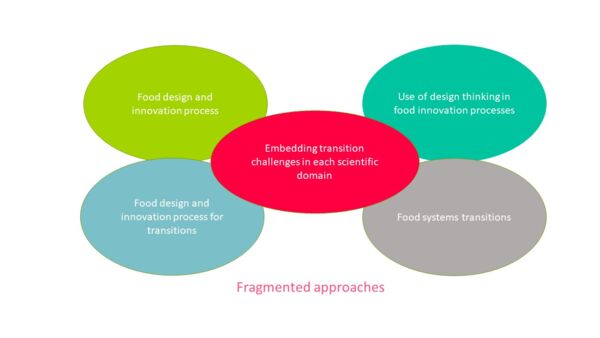
Conventional food design and innovation processes traditionally rely on fragmented approaches, where each scientific discipline works in relative isolation. Embedding transition challenges into these processes requires a paradigm shift: it is no longer merely about designing a high-performance product, but about rethinking the entire innovation process for food system transitions. Drawing on user study approaches and participatory methods throughout the design process, while also integrating scientific interdisciplinarity, enables a shift from a conventional design process to a design process for food — and other by-product-based products — for transitions.
3. Theoretical framework: design for sustainability
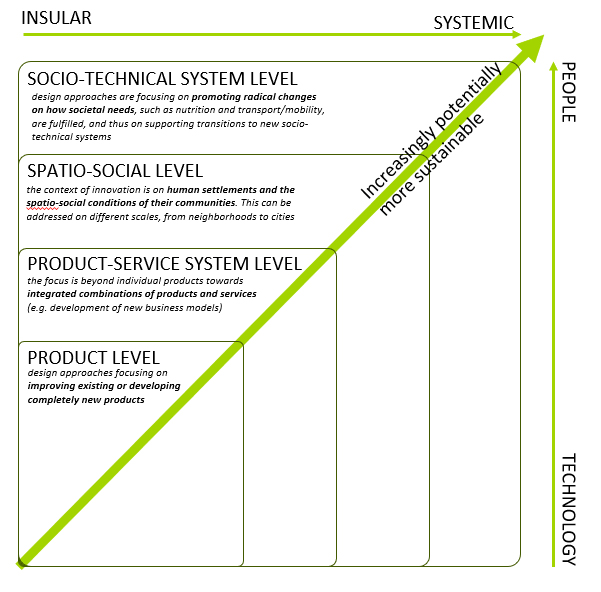
The team builds on the theoretical framework of design for sustainability (Ceschin & Gaziulusoy, 2016), which identifies a two-stage historical evolution. The first stage, the concept of design for “X” (Andreasen et al., 1990), involved designing products that, in addition to their customer use properties, could satisfy the constraints and expectations of production, repairability, cost, etc., progressively implying increasing complexity in specifications and an expanding range of competences within design teams. The second stage, from the 2000s onwards, introduces the concept of design for sustainability structured into four contribution levels, from the most insular to the most systemic:
- Level 1 – Product: design approaches focus on improving existing products or developing entirely new ones.
- Level 2 – Product-service system: the scope extends beyond the individual product towards integrated combinations of products and services, including the development of new business models.
- Level 3 – Spatio-social: the innovation context addresses human settlements and the spatio-social conditions of their communities, at different scales (from neighborhoods to cities).
- Level 4 – Socio-technical system: design approaches aim for radical changes in the way societal needs (nutrition, mobility) are fulfilled, thereby supporting transitions to new socio-technical systems.
F. Ceschin, I. Gaziulusoy, 2016, https://doi.org/10.1016/j.destud.2016.09.002.
This framework calls for multidisciplinary and open science. The CIDS team currently contributes at levels 1 and 2, with active reflection on level 3. Its ambition is to systematize feedback loops with level 3 and to continue scaling up.
4. Our proposal and positioning
CIDS brings together a multidisciplinary team that simultaneously contributes to the production of disciplinary knowledge and the development of methodological frameworks for sustainable design and innovation. The objective is to foster the emergence of design processes — from idea to use — at levels 1, 2 and 3, promoting dialogue between levels and the acceptability of solutions. Current positioning covers:
- Enriched ecodesign: environmental assessment (LCA), formulation, sensory optimization and preference modelling.
- Sensory engineering coupling product and use, towards eco-efficient PSS design.
- Integration of consumption behaviors and use contexts (Design for Sustainable Behavior).
- Studies on attachment and the temporality of experience (Emotionally Durable Design extended to food products).
5. Keys to sustainable innovation
One of the keys to sustainable innovation lies in deploying interdisciplinary methodologies that enable the transfer of solutions between applications and across industrial sectors. The team demonstrates this cross-cutting capability through several concrete application cases: the full valorization of plant by-products for the circular formulation of food and bioproducts, the design of tools for reuse loops, the design of clean-label emulsions with reduced water content and high cosmetic performance, and the integration of use conditions to design more sustainable hygiene products.
5.1 . Keys to sustainable innovation
The team develops interdisciplinary design methodologies to drive new sustainable innovations, drawing on:
- Co-creation and multi-stakeholder participatory design.
- Rational constrained formulation.
- Scale-up methodology.
- Reverse engineering and sensory engineering.
- Integration of UX (User eXperience) methodologies.
- Socio-environmental sustainability assessment approaches.
- Modelling engineering.
These methodologies account for the variability, heterogeneity and temporality of new raw materials, processes, stakeholders, behaviors, descriptive data and risk levels.
5.2 Re-design questions
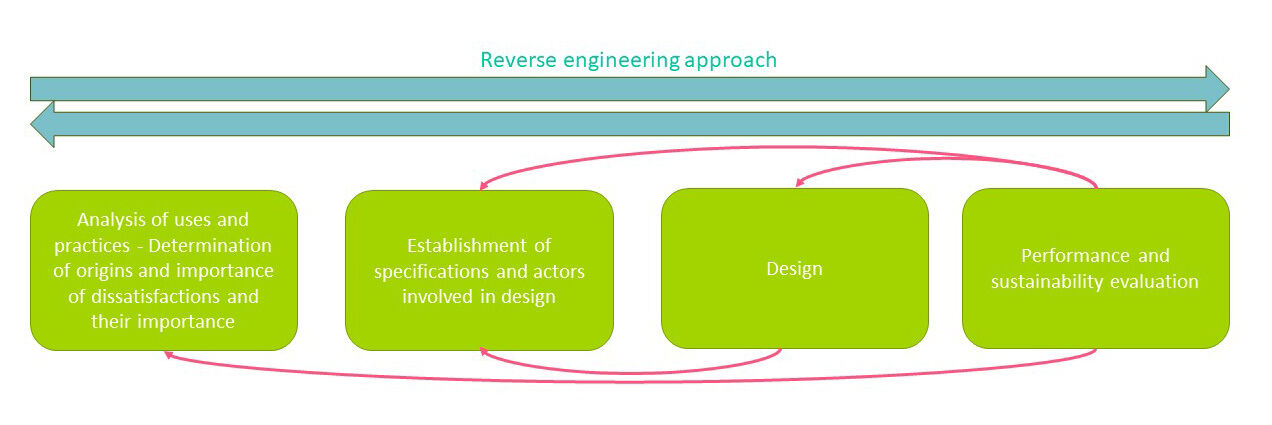
The team also deploys interdisciplinary methodologies for sustainable re-design, aimed at identifying and understanding the sources of socio-technical tensions at the design and/or use level. The objective is twofold: to help re-design key stages or the entire design process, and to capture diverted uses of market innovations to feed a re-design approach. The process follows an iterative cycle: design, performance and sustainability evaluation, analysis of uses and practices, identification of the origins and significance of dissatisfaction, and re-establishment of specifications and involved stakeholders.
6. Research questions
Research activities are structured around five axes:
- Multi-scale measurement tools and methods for structure-function properties that account for uses, moving beyond model systems to integrate an industrial “matrix effect”.
- Sensory and behavioral measurement tools and methods closer to real-life conditions (virtual reality, User eXperience).
- Modelling engineering to integrate new measurements and constraints (raw materials, processes, LCA data, consumer preferences).
- Design approaches linking social and environmental dimensions in participatory design processes for transitions.
- Reflexive postures for the emergence of sustainable design and innovation models.
7. Skills and members
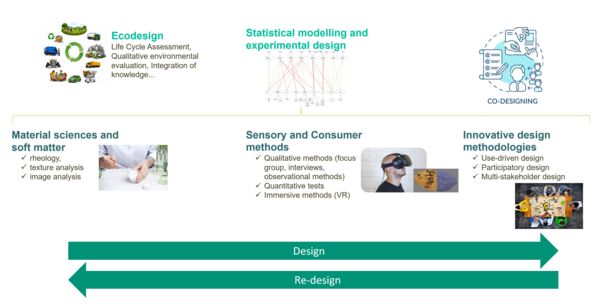
The team brings together complementary expertise: ecodesign and life cycle assessment (G. Yannou-Le Bris), materials science and soft matter — rheology, texture analysis, image analysis (D. Huc), sensory and consumer methods including immersive virtual reality approaches (D. Blumenthal, M. Masson, M. Grenier), statistical modelling and experimental design (D. Blumenthal), as well as innovative and participatory design methodology (G. Yannou-Le Bris). The team supervises several PhD students across domains ranging from plant by-product valorisation to the sustainability assessment of food systems.
8. Collaborations and projects
The team is involved in numerous collaborative projects: ANR ICAD (Coupled Innovations for Sustainable Food), ANR CLEVER (by-products for emulsion stabilization), a CNES project on culinary activity in space environments, and several CIFRE industrial PhDs (LVMH Research, Danone, Technature).
Industrial partnerships include major players in the food and cosmetics industries (Danone, Savencia, General Mills, Givaudan, Cargill, Bel, Yoplait, Pernod Ricard, LVMH, among others).
9. Trajectory and ambition
The research trajectory aims to strengthen interdisciplinarity, particularly in participatory dimensions and process engineering. The team intends to pursue its engagement at levels 1 and 2 of the design for sustainability framework, systematize feedback loops with level 3 (product-service system), and test its methodologies across a variety of products, value chains and industrial environments. The team’s strength lies in the complementarity of its expertise, enabling it to go beyond a purely academic construct to contribute concretely to food system transitions.